Showing posts with label Warhound Titan. Show all posts
Monday, 17 February 2014
Sunday, 2 February 2014
Legio Mortis VII
Back to mundane cleaning, pinning and assembly this weekend.
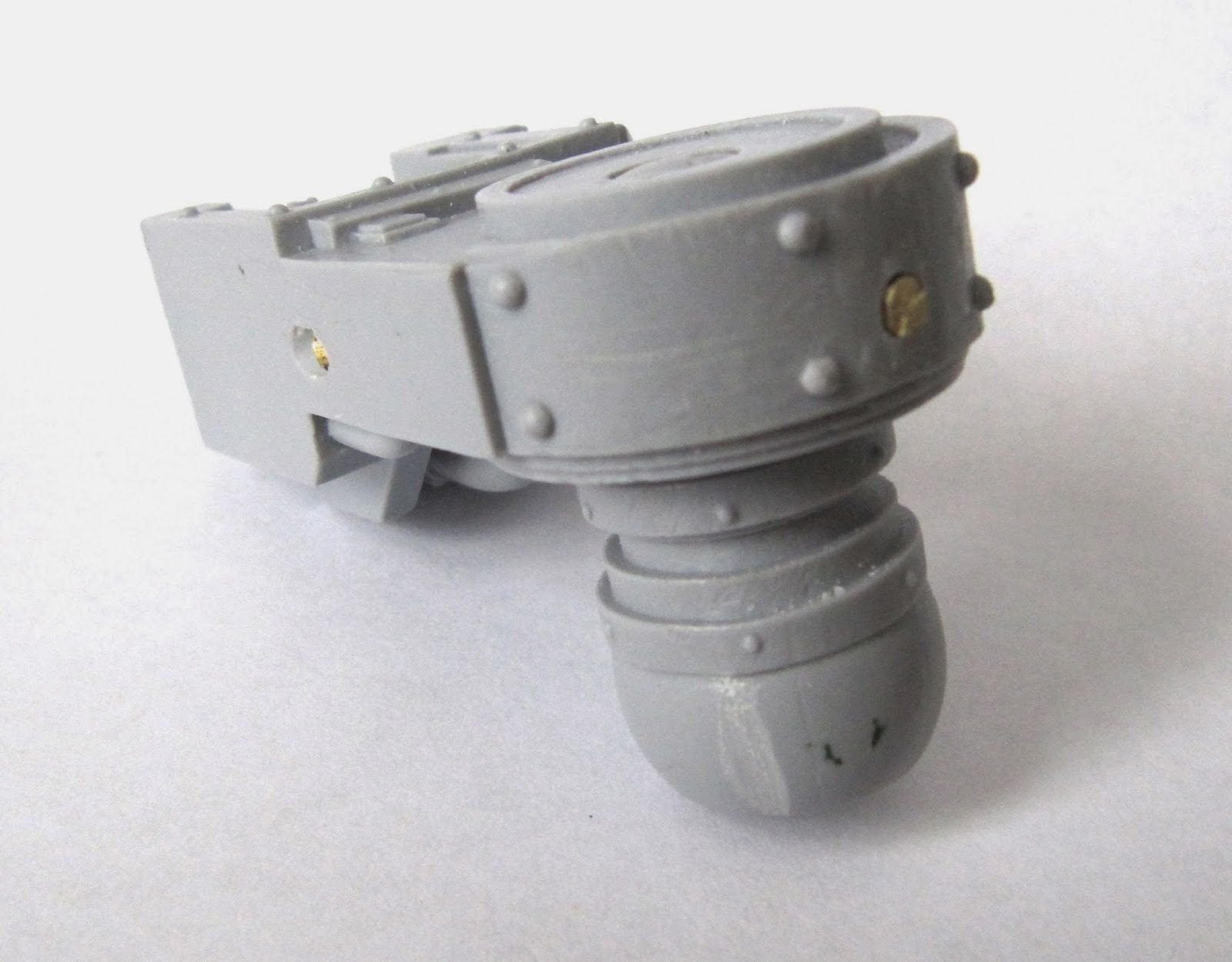
The base is then shaved down ready to receive a magnet, which is greenstuffed and glued into place.
The weapon can now be rotated left and right.
Time for undercoating...
The first pin goes all the way though from the outer edge of the shoulder. This will carry the weight of the weapon. Green stuff is then used to hide the hole. The 'arm' retains a degree of backwards and forwards movement. So a second pin comes in from the rear to fix it in place. This pin only goes halfway into the shoulder joint and the hole will be hidden by the torso:
The base is then shaved down ready to receive a magnet, which is greenstuffed and glued into place.
The weapon can now be rotated left and right.
Time for undercoating...
Sunday, 26 January 2014
Legio Mortis VI
The next session focused on painting and assembling the hull interior:
As you can no doubt see, I've used my hobby knife to cut criss crosses into those parts about to be glued together.
Next week, I'll move onto pinning the arms to the shoulders, and start painting the gun servitors.
As you can no doubt see, I've used my hobby knife to cut criss crosses into those parts about to be glued together.
Next week, I'll move onto pinning the arms to the shoulders, and start painting the gun servitors.
Monday, 20 January 2014
Legio Mortis V
So with the festivities and what not out of the way, it was time to get on with the Warhound. On assembly, I found that one of the pins holes was quite a way off line. In retrospect, I would have drilled these after assembly:
Following some advice off a Danish friend, the shield generators are attached with magnets. So if a shield goes down, one can be removed :-)
And the first of the weapons - again magnetised:
Onto painting…
Following some advice off a Danish friend, the shield generators are attached with magnets. So if a shield goes down, one can be removed :-)
And the first of the weapons - again magnetised:
Onto painting…
Sunday, 15 December 2013
Legio Mortis IV
Onto the torso.
Clean-up was fairly simple.
There's a hefty tab to cut off the rear side of the 'shoulders', but it's covered by the grills. So there's no need to spend too much time cleaning it up:
Onto the pinning. Unlike the toes and leg joints, which are there to help support the weight of the beast, pinning of the torso is designed to help to glue hold anything together. So I didn't get too carried away:
You can get away with drilling through the back piece and into the block either side of the shoulders. As it will be covered by the rear sockets (see final picture):
Next week we'll sort out the arms. I've yet to order the magnets for the weapons, but given the effect of long barrels on balance, I'll need to have them in place before fixing the final pose, glueing the feet and legs in position etc.
Clean-up was fairly simple.
There's a hefty tab to cut off the rear side of the 'shoulders', but it's covered by the grills. So there's no need to spend too much time cleaning it up:
Onto the pinning. Unlike the toes and leg joints, which are there to help support the weight of the beast, pinning of the torso is designed to help to glue hold anything together. So I didn't get too carried away:
Note the tiny holes drilled into the top of the shoulders to fix the void shield 'emitters' in place with narrow gauge brass rod. These look like the sort of part that might otherwise get knocked off 
Next week we'll sort out the arms. I've yet to order the magnets for the weapons, but given the effect of long barrels on balance, I'll need to have them in place before fixing the final pose, glueing the feet and legs in position etc.
Sunday, 8 December 2013
Legio Mortis III
As promised last week, this weekend I tackled the legs. First came the clean up, followed by dry assembly:
The hips and pelvis:
And the legs themselves. thigh, two piece knee, and lower leg with ankle joint:
I found pre-drilling with a smaller bit essential here. First I measured the centre point on either side of the outer joint, and them I drilled through. The next stage was to place the inner piece, gently push the drill bit through to mark the correct spot. I then changed the angle and repeated this to ensure the centre mark was consistent. This was then repeated for the upper joint. I hope that all makes sense:
I did not want to drill all the way through the hip ball joint as I don't expect them to be at an exact right angle to the pelvis once assembled. I pushed a cut down brass spear from my historical bits box, point outwards, and used this to confirm the centre point for the thigh joint. In both cases, the true centre point matched the centre of the disc on the thigh:
The next stage was simply to drill through with the 3mm bit and cut the brass rod to length. I drilled the outer edges first, then placed the inner joint in place to confirm positioning, before removing it and drilling in from either side. I then resaampled it and confirmed the joint by passing the drill bit in from either side again in various positions. The pre-drilling meant that there were no issues at this stage.
I did not drill all the way through to the outer edge of the thigh joint as this will make it easy to conceal with putty later.
Next week I will work on the torso and head. I need these pieces to be complete to allow me to confirm the model is in balance before fixing the various joints in the feet, legs and hips in place, attaching the pistons etc. Whilst I may fix a small base under each foot to protect them from the rigours of clumsy gaming and aid stability. I would like it to be freestanding if possible.
I'm a bit under the weather today, so unfortunately missed joining the rest of the local gaming club for a painting day. Still at least it gave me the chance to get this written up :-)
The hips and pelvis:
And the legs themselves. thigh, two piece knee, and lower leg with ankle joint:
I found pre-drilling with a smaller bit essential here. First I measured the centre point on either side of the outer joint, and them I drilled through. The next stage was to place the inner piece, gently push the drill bit through to mark the correct spot. I then changed the angle and repeated this to ensure the centre mark was consistent. This was then repeated for the upper joint. I hope that all makes sense:
I did not want to drill all the way through the hip ball joint as I don't expect them to be at an exact right angle to the pelvis once assembled. I pushed a cut down brass spear from my historical bits box, point outwards, and used this to confirm the centre point for the thigh joint. In both cases, the true centre point matched the centre of the disc on the thigh:
The next stage was simply to drill through with the 3mm bit and cut the brass rod to length. I drilled the outer edges first, then placed the inner joint in place to confirm positioning, before removing it and drilling in from either side. I then resaampled it and confirmed the joint by passing the drill bit in from either side again in various positions. The pre-drilling meant that there were no issues at this stage.
Next week I will work on the torso and head. I need these pieces to be complete to allow me to confirm the model is in balance before fixing the various joints in the feet, legs and hips in place, attaching the pistons etc. Whilst I may fix a small base under each foot to protect them from the rigours of clumsy gaming and aid stability. I would like it to be freestanding if possible.
I'm a bit under the weather today, so unfortunately missed joining the rest of the local gaming club for a painting day. Still at least it gave me the chance to get this written up :-)
Sunday, 1 December 2013
Legio Mortis II
Both feet cleaned up, drilled out and ready for pinning:
I tried to drill them out with a power Dremel, but didn't like the lack of control. So switched the 3mm drill bit to my GW hand drill and that produced much tidier results. In each case I predrilled with a much smaller bit to ensure it was central. The space is exactly 3mm, so there is no room to be off centre:
Next up, the pinned feet. At this stage the joints are still fully articulable (a little more cleaning up required on the big toe):
The pin from the big and rear toes extends into the ankle socket:
This will assist in pinning the lower leg in place:
Next week - the legs!
I tried to drill them out with a power Dremel, but didn't like the lack of control. So switched the 3mm drill bit to my GW hand drill and that produced much tidier results. In each case I predrilled with a much smaller bit to ensure it was central. The space is exactly 3mm, so there is no room to be off centre:
Next up, the pinned feet. At this stage the joints are still fully articulable (a little more cleaning up required on the big toe):
The pin from the big and rear toes extends into the ankle socket:
This will assist in pinning the lower leg in place:
Next week - the legs!
Sunday, 24 November 2013
Subscribe to:
Posts (Atom)